Reconix — Database Architecture
Comprehensive reference for the Reconix database layer: tables, relationships, data flows, state machines, read replica routing, and usage patterns.
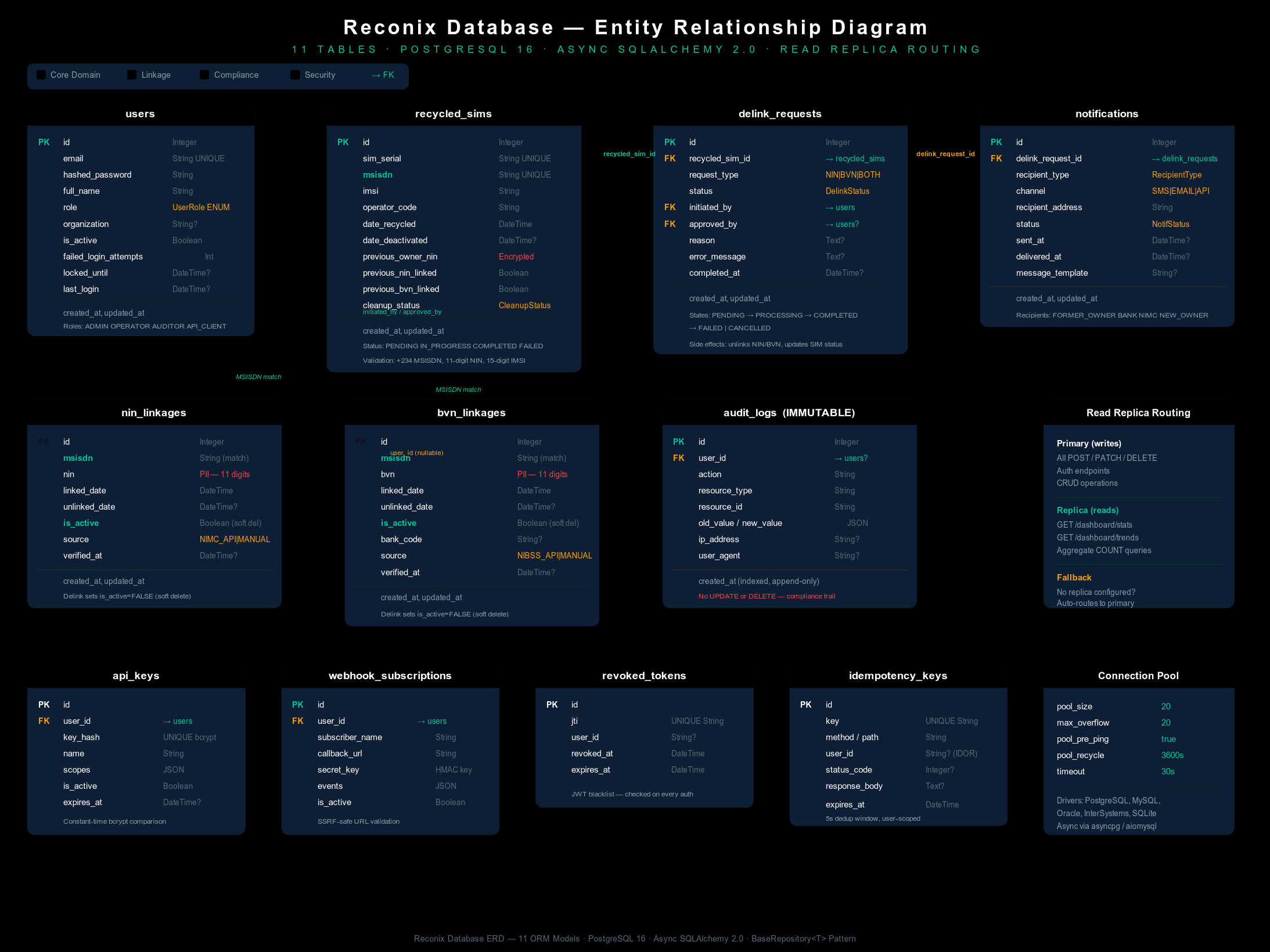
Entity Relationship Diagram
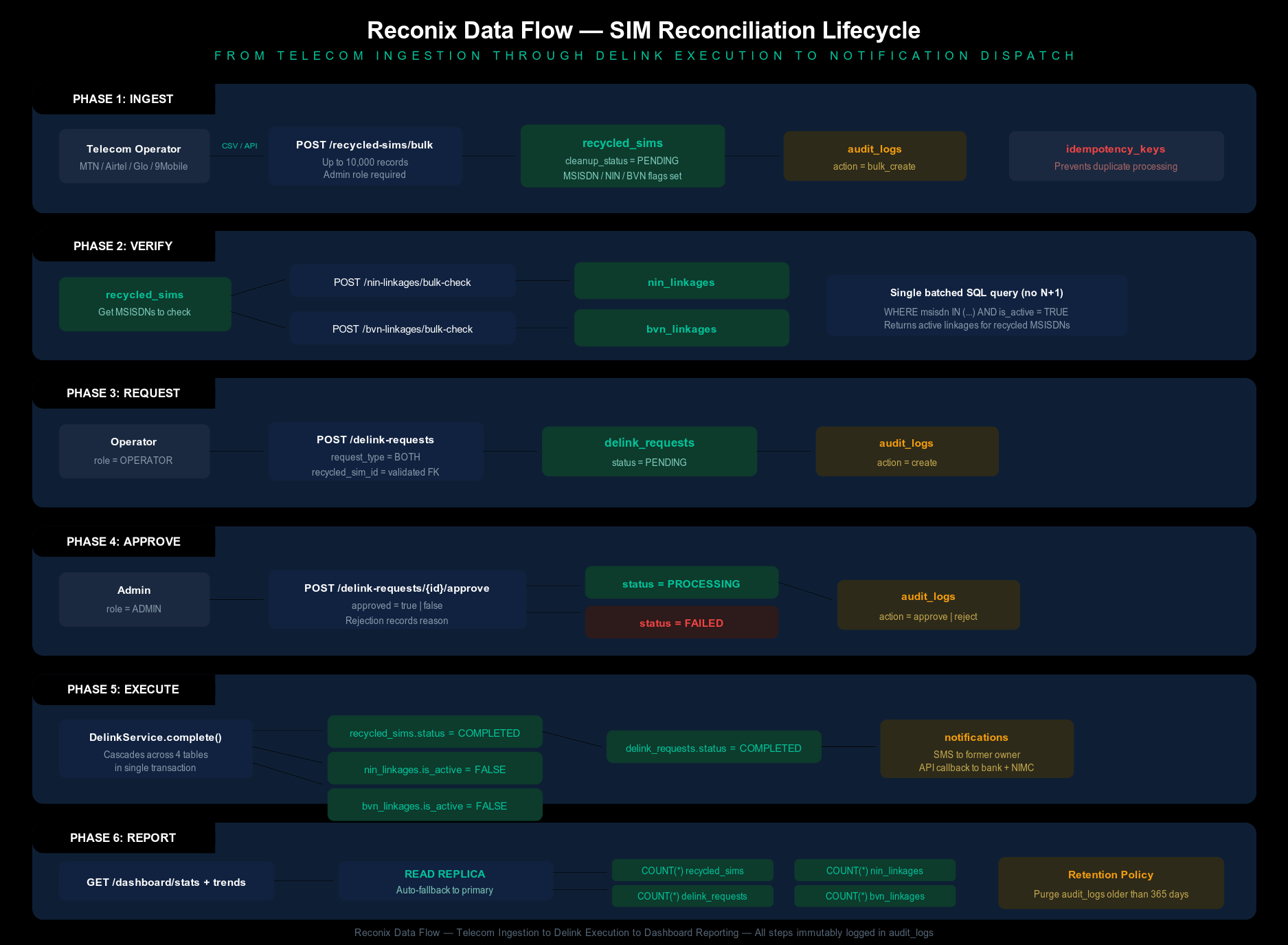
Data Flow Diagram
Infrastructure
| Component | Technology | Configuration |
|---|---|---|
| Primary database | PostgreSQL 16 (asyncpg) | Pool: 20 connections + 20 overflow, pre-ping |
| Read replica | PostgreSQL 16 (optional) | Pool: 10 connections + 10 overflow, auto-fallback |
| ORM | SQLAlchemy 2.0 async | Declarative models, BaseRepository<T> pattern |
| Session lifecycle | async_sessionmaker |
Commit on success, rollback on exception |
| Pool health | pool_pre_ping=True |
Stale connection detection before every query |
| Pool recycling | pool_recycle=3600 |
Force reconnect after 1 hour |
| Multi-driver | PostgreSQL, MySQL, Oracle | DatabaseEngineFactory adapter in db.py |
Connection Flow
FastAPI Route
    │
    ▼
Depends(get_db)  ─── or ─── Depends(get_read_db)
    │                              │
    ▼                              ▼
async_sessionmaker(primary)   async_sessionmaker(replica)
    │                              │
    ▼                              ▼
AsyncEngine (write pool)      AsyncEngine (read pool)
    │                              │  ← falls back to primary
    ▼                              ▼     if replica not configured
PostgreSQL Primary            PostgreSQL Read Replica
Tables
1. users
Stores all system accounts. Supports four roles with 19 fine-grained permissions. Includes brute-force protection via login attempt tracking and time-based account lockout.
| Column | Type | Constraints | Description |
|---|---|---|---|
id |
Integer | PK, auto-increment | Unique user identifier |
email |
String(255) | UNIQUE, NOT NULL | Login credential |
hashed_password |
String(255) | NOT NULL | bcrypt hash (12 rounds) |
full_name |
String(255) | NOT NULL | Display name |
role |
Enum(UserRole) | NOT NULL, default=OPERATOR | ADMIN, OPERATOR, AUDITOR, API_CLIENT |
organization |
String(255) | nullable | Employer or agency |
is_active |
Boolean | NOT NULL, default=TRUE | Soft disable without deletion |
failed_login_attempts |
Integer | NOT NULL, default=0 | Counter for lockout trigger |
locked_until |
DateTime(tz) | nullable | Account locked until this timestamp |
last_login |
DateTime(tz) | nullable | Last successful authentication |
Used by:
POST /auth/login— Authenticate, check lockout, updatelast_loginPOST /auth/refresh— Verify user exists viasubclaim- All authenticated routes —
get_current_userfetches from this table UserService— CRUD,increment_login_attempts(),lock_user_account()
Security controls: Constant-time dummy verify on non-existent emails (timing attack mitigation). Account locked for 15 minutes after 5 failed attempts. Same error message for invalid email vs invalid password (no user enumeration).
2. recycled_sims
Core domain entity. Each record represents a SIM card detected as recycled by a telecom operator. Tracks whether old NIN/BVN linkages exist and the cleanup lifecycle.
| Column | Type | Constraints | Description |
|---|---|---|---|
id |
Integer | PK, indexed | Unique SIM record identifier |
sim_serial |
String(50) | UNIQUE, NOT NULL, indexed | SIM card serial number |
msisdn |
String(20) | UNIQUE, NOT NULL, indexed | Phone number (+234 format) |
imsi |
String(20) | NOT NULL, indexed | International Mobile Subscriber ID |
operator_code |
String(10) | NOT NULL, indexed | MTN, GLO, AIRTEL, 9MOBILE |
date_recycled |
DateTime(tz) | NOT NULL | When the SIM was recycled |
previous_owner_nin |
String(20) | nullable, indexed | Former owner NIN (encrypted at rest) |
previous_nin_linked |
Boolean | NOT NULL, default=FALSE | Does old NIN linkage still exist? |
previous_bvn_linked |
Boolean | NOT NULL, default=FALSE | Does old BVN linkage still exist? |
cleanup_status |
Enum(CleanupStatus) | NOT NULL, default=PENDING | PENDING, IN_PROGRESS, COMPLETED, FAILED |
Used by:
POST /recycled-sims— Register a single detected recycled SIM (admin/operator)POST /recycled-sims/bulk— Bulk upload up to 10,000 records from telecom feed (admin only)GET /recycled-sims— Paginated list withcleanup_statusfilterGET /dashboard/stats— COUNT by cleanup_status for dashboard cardsDelinkService.complete_delink_request()— Setscleanup_status = COMPLETED
Validation: MSISDN validated against Nigerian format ^(\+234|0)[0-9]{10}$. NIN validated as 11 digits. IMSI validated as 15 digits.
3. nin_linkages
Tracks MSISDN-to-NIN bindings sourced from NIMC. Uses soft-delete pattern: is_active set to FALSE when delinked, preserving the historical record.
| Column | Type | Constraints | Description |
|---|---|---|---|
msisdn |
String(20) | NOT NULL, indexed | Phone number |
nin |
String(20) | NOT NULL, indexed | National Identification Number |
is_active |
Boolean | NOT NULL, default=TRUE | FALSE after delinking |
source |
Enum(NINLinkageSource) | NOT NULL, default=NIMC_API | NIMC_API, MANUAL, BULK_UPLOAD |
linked_date |
DateTime(tz) | NOT NULL | When NIMC linked this NIN to MSISDN |
unlinked_date |
DateTime(tz) | nullable | When the linkage was delinked |
Used by:
POST /nin-linkages/verify— Check if an MSISDN has an active NIN linkagePOST /nin-linkages/bulk-check— Batch check multiple MSISDNs in a single query (no N+1)NINLinkageService.unlink()— Setsis_active=FALSEduring delink execution
4. bvn_linkages
Tracks MSISDN-to-BVN bindings sourced from NIBSS. Same soft-delete pattern as NIN linkages. Includes bank_code to identify which financial institution holds the linkage.
| Column | Type | Constraints | Description |
|---|---|---|---|
msisdn |
String(20) | NOT NULL, indexed | Phone number |
bvn |
String(20) | NOT NULL, indexed | Bank Verification Number |
is_active |
Boolean | NOT NULL, default=TRUE | FALSE after delinking |
bank_code |
String(10) | nullable | Financial institution code (e.g. 007) |
source |
Enum(BVNLinkageSource) | NOT NULL, default=NIBSS_API | NIBSS_API, MANUAL, BULK_UPLOAD |
linked_date |
DateTime(tz) | NOT NULL | When NIBSS linked this BVN to MSISDN |
unlinked_date |
DateTime(tz) | nullable | When the linkage was delinked |
5. delink_requests
Workflow orchestration table. Each record represents a request to delink a recycled SIM from old NIN/BVN bindings. Implements a state machine.
| Column | Type | Constraints | Description |
|---|---|---|---|
id |
Integer | PK, indexed | Unique request identifier |
recycled_sim_id |
Integer | FK(recycled_sims.id), NOT NULL | Which SIM is being delinked |
request_type |
Enum(DelinkRequestType) | NOT NULL, default=BOTH | NIN, BVN, or BOTH |
status |
Enum(DelinkRequestStatus) | NOT NULL, default=PENDING | Current workflow state |
initiated_by |
Integer | FK(users.id), NOT NULL | Operator who created the request |
approved_by |
Integer | FK(users.id), nullable | Admin who approved/rejected |
reason |
Text | nullable | Justification for the delink |
error_message |
Text | nullable | Failure details if FAILED |
State Machine:
                ┌─────────► CANCELLED
                │
PENDING ────► PROCESSING ────► COMPLETED
                │                   │
                └──────► FAILED     │
                                    ▼
                          recycled_sims.cleanup_status = COMPLETED
                          nin_linkages.is_active = FALSE
                          bvn_linkages.is_active = FALSE
                          notifications created for affected parties
Side effects on completion:
recycled_sims.cleanup_statusupdated toCOMPLETEDnin_linkagesmatching the SIM’s MSISDN are soft-deletedbvn_linkagesmatching the SIM’s MSISDN are soft-deletednotificationscreated for former owner, bank, and NIMC
6. notifications
Tracks multi-channel notification dispatch to affected parties during the delink workflow.
| Column | Type | Constraints | Description |
|---|---|---|---|
delink_request_id |
Integer | FK(delink_requests.id), NOT NULL | Which delink triggered this |
recipient_type |
Enum(NotificationRecipientType) | NOT NULL | FORMER_OWNER, BANK, NIMC, NEW_OWNER |
channel |
Enum(NotificationChannel) | NOT NULL, default=EMAIL | SMS, EMAIL, API_CALLBACK |
recipient_address |
String(255) | NOT NULL | Phone number or email address |
status |
Enum(NotificationStatus) | NOT NULL, default=PENDING | PENDING, SENT, DELIVERED, FAILED |
7. audit_logs (IMMUTABLE)
Append-only compliance trail. Every state-changing action is logged with before/after values, IP, and user agent. Records cannot be updated or deleted through the ORM.
| Column | Type | Constraints | Description |
|---|---|---|---|
user_id |
Integer | FK(users.id), nullable | Who performed the action (null=system) |
action |
String(100) | NOT NULL, indexed | create, update, delete, login, etc. |
resource_type |
String(100) | NOT NULL, indexed | RecycledSIM, DelinkRequest, User, etc. |
resource_id |
String(50) | NOT NULL, indexed | ID of the affected resource |
old_value |
JSON | nullable | State before the change |
new_value |
JSON | nullable | State after the change |
ip_address |
String(45) | nullable | Client IP (IPv4 or IPv6) |
PII handling: All log output passes through PIIMaskingFilter which redacts NIN/BVN/MSISDN patterns before writing to stdout. The JSON fields may contain PII but are only accessible to admin/auditor roles.
8. api_keys
Machine-to-machine authentication for external system integrations. Keys are stored as bcrypt hashes with constant-time comparison.
9. webhook_subscriptions
Event subscription management for external stakeholder sync. Banks and NIMC register callback URLs to receive delink event notifications. Callback URLs are validated server-side (SSRF protection blocks private IPs, loopback, and cloud metadata endpoints).
10. revoked_tokens
JWT blacklist table. Stores JTI claims of revoked tokens. Checked on every authenticated request and during token refresh. Expired entries are auto-cleaned via TokenRevocationService.cleanup_expired().
11. idempotency_keys
Request deduplication table. The IdempotencyMiddleware intercepts POST/PUT/PATCH requests carrying an Idempotency-Key header. If the key has been seen before, the stored response is replayed. Keys are scoped per-user to prevent IDOR.
End-to-End Data Flow
Step 1: SIM Ingestion
Telecom CSV ──► POST /recycled-sims/bulk ──► recycled_sims (up to 10,000 rows)
                                                cleanup_status = PENDING
Step 2: Linkage Verification
POST /nin-linkages/bulk-check ──► nin_linkages WHERE msisdn IN (...) AND is_active=TRUE
POST /bvn-linkages/bulk-check ──► bvn_linkages WHERE msisdn IN (...) AND is_active=TRUE
Both queries are batched into a single SQL WHERE IN clause (no N+1).
Step 3: Delink Request Creation
POST /delink-requests ──► delink_requests (status=PENDING, request_type=BOTH)
                              validates recycled_sim_id FK exists
Step 4: Admin Approval
POST /delink-requests/{id}/approve ──► status = PROCESSING (or FAILED on rejection)
Step 5: Delink Execution
DelinkService.complete_delink_request()
    ├── recycled_sims.cleanup_status = COMPLETED
    ├── nin_linkages.is_active = FALSE
    ├── bvn_linkages.is_active = FALSE
    ├── delink_requests.status = COMPLETED
    └── notifications created (SMS + API callbacks)
Step 6: Dashboard Reporting (via Read Replica)
GET /dashboard/stats ──► COUNT(*) recycled_sims GROUP BY cleanup_status
                         COUNT(*) nin_linkages WHERE is_active=TRUE
                         COUNT(*) bvn_linkages WHERE is_active=TRUE
                         COUNT(*) delink_requests GROUP BY status
Read Replica Routing
When DATABASE_READ_REPLICA_URL is set, dashboard queries are routed to the replica. All write operations use the primary. If no replica is configured, all queries fall back to the primary transparently.
| Dependency | Engine | Routes |
|---|---|---|
get_db() |
Primary | All write routes, auth, CRUD operations |
get_read_db() |
Read replica | GET /dashboard/stats, GET /dashboard/trends |
Retention and Cleanup
| Table | Retention Policy | Cleanup Mechanism |
|---|---|---|
audit_logs |
AUDIT_LOG_RETENTION_DAYS (365) |
POST /retention/purge-audit-logs (admin) |
revoked_tokens |
Until expires_at passes |
TokenRevocationService.cleanup_expired() |
idempotency_keys |
5-second dedup window | Automatic expiry via expires_at |
| All other tables | No automatic purge | Manual via admin operations |